Monday, 27 February 2012

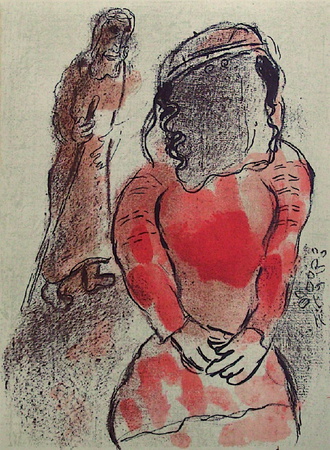
6. Tamar - I've waited too long.

As husbands go, Tamar is spectacularly unlucky. To begin with she marries the eldest son of Judah, (Jacob's fourth son by Leah.) 


But he is bad, and then dead. 


Next she marries his brother, hoping to have children by him that will inherit the older brother's estate, but this doesn't appeal to the bridegroom so he, to put it politely, as the bible does, 'spills his seed'. 


So he is also bad, and then also dead.


Tamar is now a double widow and childless. Judah promises his youngest son to her (when he comes of age) but when he does grow up there is still a distinct ongoing absence of wedding bells. In reality Judah is content for her to die a widow, lonely and unmarried. Being an enterprising woman who owns a few veils she decides to take matters into her own hands.


At this point, suspend all notions of 21st Century acceptable moral behaviour, and remember that in this story all the males come off consistently worse than the female....


Tamar dons one of these veils, a particularly fetching one, and goes out to meet her father in law on the road. Mistaking her for a prostitute he sleeps with her in return for.......(some heavy gold coins/a necklace of pure silver/a bushel of fine spices?)


.....a goat.


She really wants that goat so as a pledge, he leaves his seal and staff with her, and later sends the goat to her via a friend, to get his seal and staff back. But she is nowhere to be found.


Three months later, Tamar is discovered to be pregnant. In an unbelievably hypocritical storm of fury, Judah orders her to be put to death for unlawful prostitution. She swiftly sends him a message, along with the seal and staff - 'I am pregnant by the man who owns these (Gen. 38:25).


At last Judah admits his fault - he ignored her sad plight and withheld his third son from her. She is 'more righteous than I' (Gen. 38:26). A pretty amazing admission for an, as yet, unreconstructed Old Testament male. Tamar will, through the birth of twin boys, have an honoured place in the blood line of the Messiah, who is graciously not above being born from such bizarre ancestral goings on.

Sunday, 26 February 2012

5. Rachel - the dubious blessing of motherhood.

'Lord help the Mister, who comes between me and my sister, and Lord help the sister who comes between me and my man', as the song goes...


It's a mixed up tale of love, deceit, mistaken identity, jealousy, infertility and a lot of half brothers. Rachel is loved by Jacob but in the near Eastern manner of veils and darkened bridal tents, Jacob is tricked into marrying/sleeping with her eldest sister, Leah, first. (N.B. best to make good eye contact on your wedding night...)


But Jacob is not to be put off that easily. In the manner of swooning lovers he has already toiled seven years in the fields for her and after a week of Leah he marries Rachel as well, thus setting up a compromised marital scenario of sisterly/maidservantly jealousy and strife extending way into the future as eventually four different women compete to bring children into the same family.


Rachel means 'ewe', a mother sheep, but motherhood is a long time coming. Infertility can make you desperate - she cries to Jacob, 'give me children or I'll die.' (Genesis 30:1) which turns out to be sadly prophetic. Her prayer for a baby must have been a persevering one: 'Then God remembered Rachel; he listened to her and opened her womb' (Gen. 30:22). After the joy of Joseph (Jacob's favourite) she dies giving birth to Benjamin, the youngest. 


From extremely unlikely beginnings, despite human frailty and a family tree to baffle even 'Who do you think you are?', Joseph and his Amazing Technicolour Dreamcoat is now an assured future West End reality.


Which just goes to show that the course of true love (and motherhood) never did run smooth.


Saturday, 25 February 2012

4. Rebekah - have nose-ring, can travel.

As far as the Israelites were concerned I guess the first born males had it quite bad in the pre-anaesthetic department (I'm thinking foreskins and flint) but can anyone shed light on how you get a nose ring through a total stranger's nostril on meeting her at the local well? This is Rebekah's story and she seems a remarkably together young woman to leave everything at a moment's notice for a life of wifely obedience in Cana (the fact that she turns out to be quite a dab hand at wheeling and dealing herself comes later...)

You really have to get into Ancient mindset here. It's not so much 'Would you like to leave your family and come away to a foreign land to marry a man more than twice your age, whom you have never met?' more 'It would seem you have been divinely chosen to be honoured with wealth, status and marriage to your first cousin once removed, not to mention receiving a whacking piece of gold through your nose.'

Amazingly for a society where ownership of women was an entirely normal concept, there does appear to be some leeway offered to her with regards to the wife-hunting project: 'Let's call the girl and ask her about it' (Genesis 24:57). But she is game and off she goes.

Now I'm a terrible romantic, so here's how the episode ends: 

The camels, weary from the long journey, slow to a halt as they approach the field where Isaac, fresh from the Negev, is 'meditating' ('Gosh, I'll need a bath sometime...') Rebekah, getting down from her camel, spots him walking across the field (a bit like the end of the Kiera Knightly Pride and Prejudice film...swelling music...) Rebekah asks the servant 'Is that HIM?' and when told yes, veils herself, being a modest young woman. Isaac is quickly informed, 'By the way, this is your bride.' And the text says 'Isaac brought her into the tent of his mother, Sarah, and he married Rebekah. So she became his wife, and he loved her; and Isaac was comforted after his mother's death.' (Gen. 24:67).

Ahhhhhhhhhhhhhhhhhhhhhhhhhhhhhhhhhhhhhhhhhhhhhhhhhhhhhhhhhhhhhhhhhhhhhhhhhhhhhh.

Friday, 24 February 2012

3. Hagar - 'Where have you come from and where are you going?'

There's a whiff of Eastern promise in the air...the hot desert sun, the tent, the attentive Master, the hope of something better for a slave-girl nobody. Then it all goes horribly wrong....

It's always in the desert where God finds us and it was the same for Hagar. She was an Egyptian; a slave; young; beautiful. Finding yourself pregnant by the mistress's husband is never a good living/working arrangement and female bullying is a horrible reality. She flees to the wilderness in despair. There's nothing like a pregnancy to remind you of the frailty of human life. Things happen to you beyond your control. Another being is brought into the world and they are your responsibility. You worry about the mess you are brining the child into. It's very probable that God doesn't exist and we must make our own way alone.

But then hope. A spring of water in the desert. This is where God finds Hagar and asks perhaps the oldest question of all: 'Where have you come from and where are you going?' (Genesis 16:8.)
It's not Existentialism after all! 
Someone sees and Someone cares.

At the spring of water, there's a promise of blessing for the new life swimming within her. Hagar names the well 'Beer-lahai-roi' - 'the well of the Living One who sees me.' 
God sees and finds a desperate, pregnant woman and she responds in a beautiful act of divine re-naming.

It's all in the eyes...


Thursday, 23 February 2012

2. Sarah - 'You have got to be joking...'

Second day of Lent and it's Sarah up next.

If women are increasingly postponing the age at which they give birth to their first child, none of us has anything on Sarah. She is introduced in Genesis 11:30 with the chilling words 'Now Sarai was barren...' and, in case we needed clarification, '...she had no children.' As far as the bible goes this has never been an obstacle for God - in fact it appears to be almost a qualification for women whose sons are later to assume major importance in salvation history. Is this to remind us that the initiative and the power to bring to birth is always God's?

Her long awaited son is named after her understandable reaction when told, at the age of 90, she will give birth within the year - i.e. 'you have got to be having a LAUGH.'

I take my hat off to Sarah - she is nothing if not robust. I'm not sure I would have the courage to laugh in the face of a heavenly messenger - John the Baptist's father failed to believe a similar angelic message and look what happened to him (couldn't speak for nine months.)

The conversation about Sarah's impending unlikely conception is actually quite surreal:

Divine Messenger (to Abraham) : 'I will return this time next year and Sarah will have a son.'
Sarah (eavesdropping through the tent flap): 'After I am worn out and my master is old, will I now have this pleasure?' (wonderful euphemism for 'I'm past all that business')
Divine messenger (ears like lasers): 'Why did Sarah laugh and say 'will I really have a child?'
Sarah: (lying) 'I did not laugh'
Divine Messenger: 'Yes, you did laugh.'

Long Pause.

You couldn't make it up if you tried.
So here's to Sarah, laughter and pleasurable surprises in old age.


Wednesday, 22 February 2012

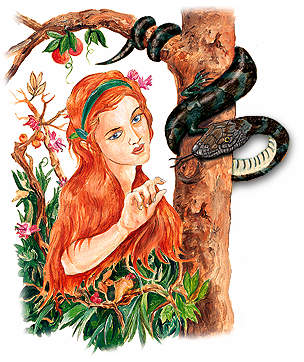
Fabulous 40 for Lent: 1. Eve, mother of all the living.

Here's a challenge - can you name 40 faithful females from the bible? On the first attempt without looking anything up I ground to a halt at 29....Come on ladies, there must be more of you! Eventually I came up with a FABULOUS 40 - one for each day of Lent. So here goes...

First up - Eve.
Apparently there's a female rapper of this name, so my initial foray into Google images got nowhere - I had to type in 'bible Eve.'
So 'bible Eve', in pictures, is mostly saddled with the serpent; nasty crafty creature, and of course that apple of temptation, now probably the most iconic brand image in the world.
But is there anything to emulate in Eve, the first of the fabulous 40?

  • Her name is palindromic and very easy to spell
  • She's created in the divine image. (Wow, what does that say about God?)
  • She makes the man whole.
  • She is 'the mother of all the living' (Gen. 3:20)
  • She had faith 'I have brought forth a man with the help of the Lord.' (Gen. 4:1)
  • She loses a son; another becomes a murderer, and she gives birth to another without apparently losing that faith - 'God has appointed for me another child' (Gen. 4:25)
Not bad going for an icon of temptation.
Thanks for kicking things off in more ways than one, Eve.

Friday, 17 February 2012

afraid of secularisation?

Iconic spires litter the British countryside

Since the successful banning of prayers as part of the agenda of council meetings in Bideford, Devon, there has been a lot of talk about the ongoing march of secularisation in Britain. I occasionally wonder if the perception of secularisation is stronger amongst believers than amongst the general public. If you were asked 'Is Britain a secular democracy or a Christian country?' what would you answer? 

The Church of England is established in law but, as Richard Dawkins was at pains to point out recently, most people who self identify as 'Christian' in polls, rarely read the bible or go to church. Perhaps the National Secularist Society now want to move onto banning prayers at the beginning of Parliament, or promote the separation of Church and State so traditional Remembrance Day services in which we sing the National Anthem ('God Save the Queen' - a prayer) will become impossible.

Lord Carey, former Archbishop of Canterbury, has recently co-authored a book called 'We don't do God', a reference to Alistair Campbell's now infamous response to a journalist trying to get Tony Blair to discuss faith. This 'official' political line has never stopped politicians pronouncing, at news of tragic or violent deaths, that 'our thoughts and prayers are with the family...' 

However, politics and faith seem to be slightly easier bedfellows these days, with Cameron at least admitting that his Christian faith is a bit like a poor radio signal - 'it comes and  goes.' Where legal rulings have come down against individual Christians for practices which appear to be at odds with Equality Law, and those individuals are described as being 'persecuted', I'm afraid I do part company - being persecuted is what Christians in Nigeria, China and Egypt face and it involves physical harassment and often torture and death.

So how secularised are we?

Something that stayed with me recently on travels around the countryside was the proliferation of church spires visible from train and car windows. Apparently on TV shows about desirable locations they always show a shot of a spire as a kind of background reassurance that this place is a good place to live. I wondered about a countryside devoid of spires...this would be secularism taken to its logical extreme. 

Alain de Boton might be upset there were no churches to give his devotees a warm spiritual glow (without of course any actual substance) but what the absence of churches would say would be that there is no upward, vertical direction to our human existence, just a horizontal one as we (rightly) reach for human relationship and love. But our love is fuelled by His - 'we love because He first loved us' (1 John 4:19.) God made the first move and always does. A spire points us to heaven and suggests we need something more than just each other and the things we perceive with our senses. I think a lot of people who are at best lukewarm about the church, would be quite upset at the thought of a full blown secularisation in the UK. It just might prove to be less tolerant than the dear old C of E.